
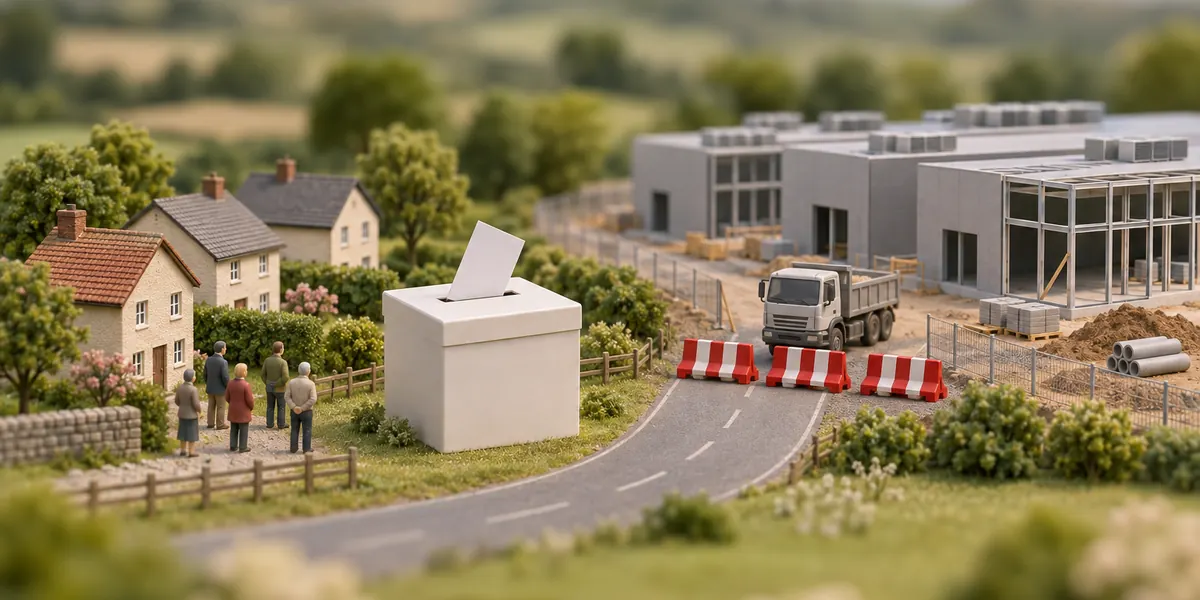
Data centers became a ballot issue in the 2026 US midterms. Tallies from several organizations point the same way: local voters mostly sided against them.
404 Media counted more than 40 elections in 13 states that touched on data centers, with at least 38 ending badly for the industry. Six cities voted for outright bans, and 12 cities capped projects by megawatts of power draw. Ars Technica, citing tracking by Redbud Consulting, put it at 38 of 44 restriction proposals passing across 10 states. The two counts differ on both the number of states and the totals, and ballots are still being counted, so final results should be treated as the reference.
The one exception mentioned is Harwood, North Dakota, where the approved measure lets projects go ahead but requires developers to pay for an independent assessment and to hold public hearings.
Candidates caught up too
Texas drew the most attention. Democrat Gina Hinojosa beat Governor Greg Abbott, who was seeking a fourth term, by more than 700,000 votes. Abbott said last year that Texas was the center of AI development, and 404 Media says he has taken more than $9 million in data-center-related donations. Hinojosa has called for pausing projects until the state passes laws protecting water, power, air and property rights.
Local results were more direct. In Burgin, Kentucky, a mayoral candidate who backed large projects lost to a write-in candidate opposed to data centers. The mayor of Yukon, Oklahoma, lost a recall vote. Emporia, Kansas, passed a ban on high-impact data centers, and both Asheville, North Carolina, and San Marcos, Texas, elected mayors who campaigned against data centers.
Polling echoes this. NBC exit polls show roughly three in four voters oppose data centers, and more than half said AI and data centers were a key or important factor in their congressional vote. Electricity bills, water use and air pollution were the reasons cited most often.
Sizing up what is affected
By a rough calculation, the pass rate on Redbud's count is about 86%. That is high, but analysts' estimates of the actual impact need to be read separately:
- Timing: analysts say the measures mainly affect new projects planned for 2028, while projects already under construction or approved before 2027 are not affected;
- Texas: Bloomberg estimates about 13GW of capacity is at risk, and Axios says Texas is expected to account for more than 41% of new capacity in 2028;
- Nationwide: Democrats also won the governorships of Arizona, Georgia and Ohio. Axios estimates that nearly two-thirds of 2028 capacity could face similar delays, and Bloomberg estimates that about half of data centers become easier to scrutinize;
- Size of the delay: GLJ Research's Gordon Johnson says projects lacking state environmental permits could slip 12 to 18 months, with some moving to Louisiana or Georgia.
These are estimates from investment banks and media, and Texas has not yet settled on specific policy. How far Hinojosa's call for a pause can go depends on the state legislature, and there is no bill text to check at the moment.
Musk becomes the most visible loser
Elon Musk spent the most money in this election cycle, though accounts of the amount vary: the Financial Times previously reported more than $275 million, the Washington Post estimated $446 million, and Quartz put it at nearly $500 million as of October. The FT reports the election has cut his wealth by more than $60 billion, with SpaceX down 3.8% and Tesla down 3.6% in premarket trading.
Texas is home to Tesla, SpaceX and the two companies' joint chip project. According to SemiAnalysis, SpaceX raised its 2027 data center capacity target from 10GW to about 13GW, with more than 9GW already locked in. On election night he posted on X:
"Data centers in space looking pretty appealing right now"
How the tech industry reads it
Adam Kovacevich, CEO of Chamber of Progress, argues this cannot be counted as a rejection of tech, since voters were focused on the economy:
"Let's not confuse an anti-Trump wave with an anti-tech mandate."
On the other side, Brad Carson, co-founder of Americans for Responsible Innovation, called it an "AI earthquake." Ali Mortell of Blue Rose Research said voters in the two parties do not differ markedly in their views.
Change at the federal level may come far more slowly. Michael Strobaek of Lombard Odier points out that Trump can still veto federal legislation, and overriding a veto would need many Republican lawmakers to cooperate. For cloud providers, the more practical pressure right now sits on state and county approval desks.
Sources: 404 Media, Ars Technica, CocoLoop, Financial Times, Redbud Consulting, and estimates from Bloomberg and Axios; votes are still being counted, so figures follow each outlet's own methodology.