
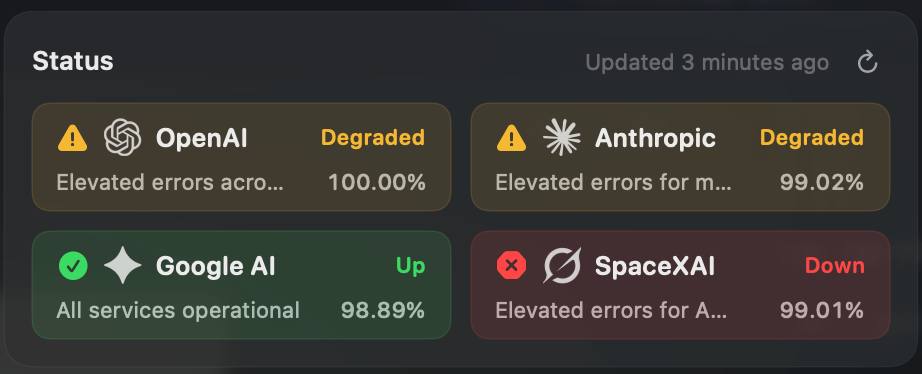
On the evening of September 3 Beijing time, model services from Anthropic, xAI and OpenAI entered outage status in succession within an hour and a half. Anthropic’s status page posted its first notice at 21:26 Beijing time (13:26 UTC); xAI’s entire Grok lineup was flagged as degraded by a downstream platform at 21:41; OpenAI began reporting elevated error rates for ChatGPT and Codex around 22:56. By 23:15, all three incidents were still listed as “investigating” or “fix in progress” — none had declared a recovery.
Over the same window, Google’s Gemini and Vertex AI logged no incidents — on a third-party status aggregator, Google’s tile stayed green: “All services operational.”
Timeline: three vendors, one after another
Anthropic first. At 21:26, the status page read “Investigating elevated error rates for Claude Mythos 5.1, Fable 5.1 and Opus 5.” Fifteen minutes later that changed to “cause identified, fix in progress.” A full list followed at 21:50: both the 5.1 and 5 generations of Mythos and Fable, plus Opus 5, Opus 4.8 and Opus 4.6, were all affected; Haiku and Sonnet were not on the list. The 22:49 update carried just one line: “still working on a fix.”
xAI followed closely. xAI’s own status page returned a 403 when fetched, so it couldn’t be checked directly. What could be confirmed: Cursor posted an “investigating degraded service” notice at 21:41, naming “all Grok models, Automations, Cloud Agents, Grok Bot and Review Agents” as affected. On the aggregator, xAI was the only one of the four marked red — “Down.”
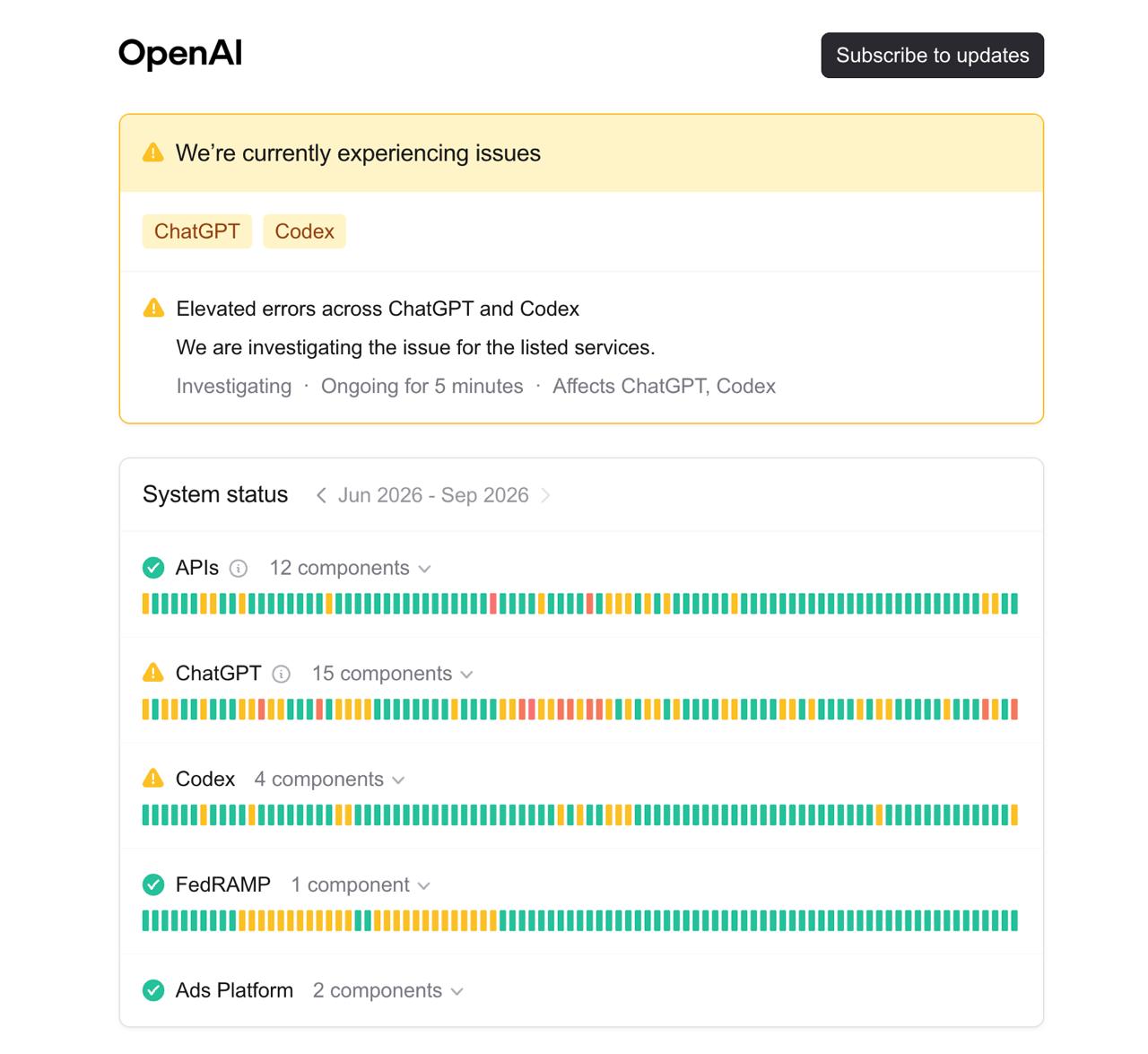
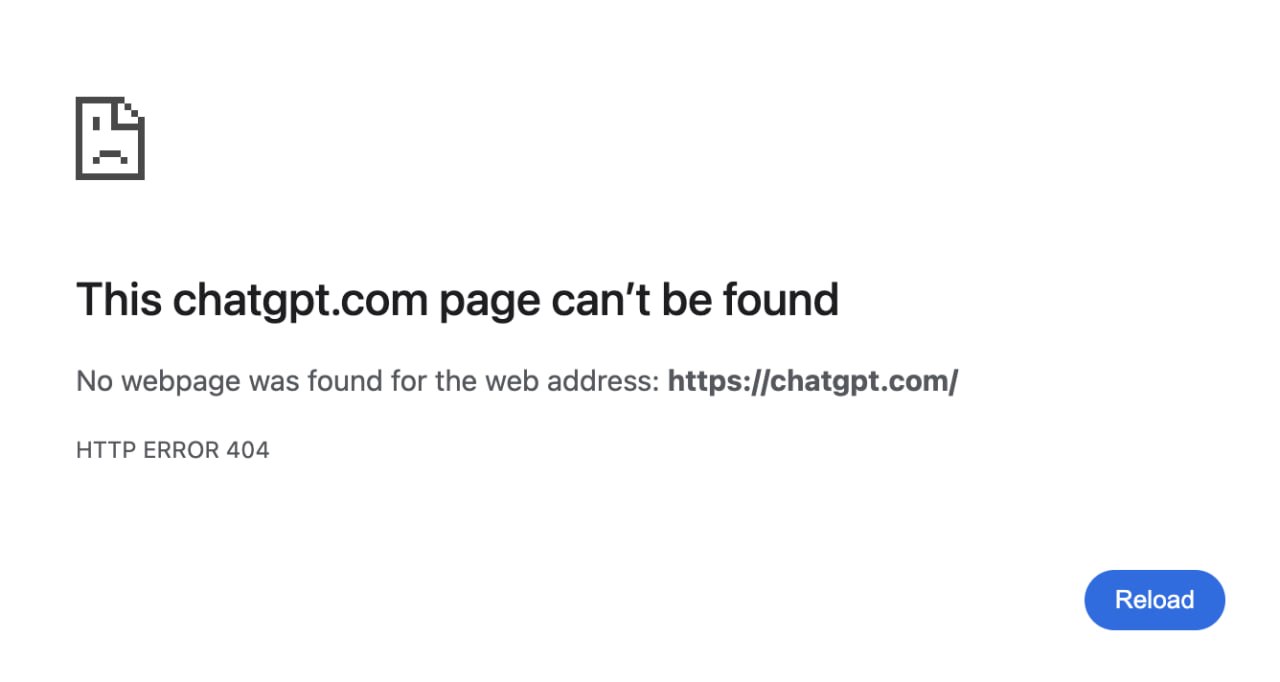
OpenAI came last, and users felt it most. Around 22:56, its status page showed “Elevated errors across ChatGPT and Codex,” with just one line of explanation: “investigating.” Some users who opened chatgpt.com at that point got an HTTP 404 — an error code that usually comes from an edge node failing to resolve a route, a different kind of failure from a 5xx error on the model side.
Downstream noticed first
Cursor’s status page carried two incidents at once that night. One was the 21:41 Grok degradation; the other, posted at 22:17, was “elevated error rates on Anthropic models,” attributed to an “upstream Anthropic issue” causing request failures on Fable 5.1, Fable 5, Opus 5, Opus 4.8 and Opus 4.6, with “some users experiencing errors or failed agent turns.”
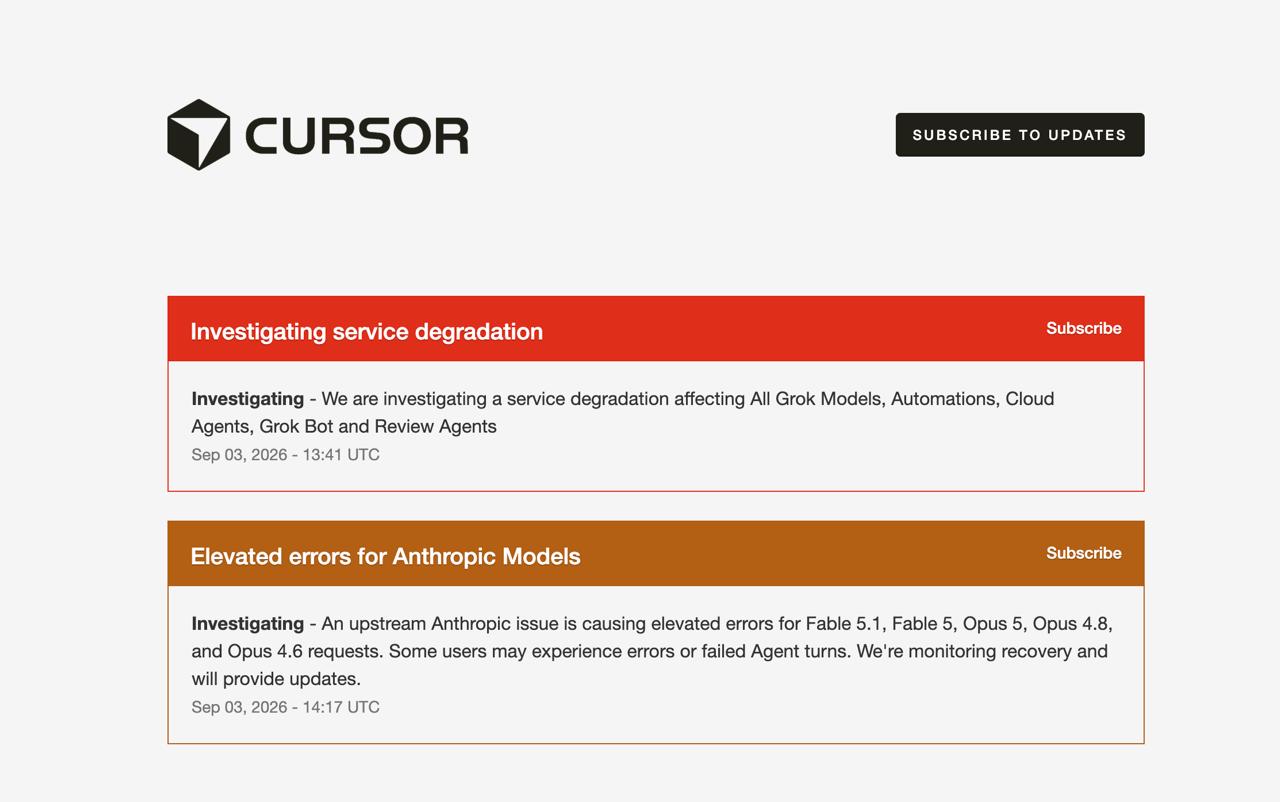
That list matches the one Anthropic itself published, minus Mythos, which Cursor doesn’t integrate anyway. For an AI coding tool, having two upstream providers go down on the same night puts a real dent in the fallback promise behind “multi-model redundancy.”
Developers in China were in a more passive position. Most of them go through relay APIs or aggregator platforms, so outage information reaches them secondhand — relay providers typically just show “upstream error” without specifying which vendor or which model. Tonight, Claude’s Haiku and Sonnet weren’t on the affected list, and Gemini stayed available throughout; those who knew that could switch models directly, while those who didn’t could only keep refreshing and wait.
Google was fine — a clue, or a coincidence?
The first theory to surface in Chinese tech communities was an upstream network or DNS problem. That theory can’t currently be verified. Two pieces of evidence argue against it: Google Cloud’s incident list had no new entries that day, and Gemini stayed up all day; and Anthropic’s own wording — “cause identified” — points inward, toward its own systems, whereas a shared-infrastructure failure is typically phrased as an “upstream provider” issue.
There’s also evidence in favor. Everything Anthropic listed as affected was a large model; its smaller models were untouched. xAI’s notice named “all Grok models.” OpenAI listed only ChatGPT and Codex, while its API status stayed green. All three outages clustered around large models on the inference side — a pattern that looks more like a regional compute-provider problem than a DNS failure, which would typically take everything down at once.
A third-party availability monitor offers another point of comparison. As of 23:37 Beijing time (15:37 UTC) it flagged nine services: besides Cursor, Claude and OpenAI, it listed partial degradation at Cloudflare, Supabase, GitHub, Notion, SendGrid and Twilio. The list looks like support for the shared-upstream theory, but Cloudflare's own status page added no new incident that evening; the two open items were R2 and WARP issues left over from late August, and there is no evidence linking the other degradations to tonight's event. The same page showed Grok back to operational at 23:37.

What these clues actually support is only this: three vendors each had trouble with large-model inference in the same window. Anything beyond that is speculation. None of the three has published an incident report, and none of their public updates mention any third party. Which explanation holds up will have to wait for each company’s post-mortem, which typically takes three to five business days.
Sources: Anthropic status page, OpenAI status page, Cursor status page, Google Cloud incident list, CocoLoop community user screenshots; each vendor’s affected-model list and incident stage were checked against the original status-page text. xAI’s own status page returned a 403 when fetched, so the scope of its outage is based on Cursor’s status page and third-party aggregators.