
DeepSeek opened the final V4-Flash API for public beta on July 31. The scope is narrow: the web and app models did not change, and neither did the V4-Pro API. The update is aimed at developer interfaces, coding agents and Codex workflows.
The headline figure is 82.7 on Terminal Bench 2.1. DeepSeek's comparison chart lists 61.8 for the V4-Flash preview and 72.1 for the V4-Pro preview. That is a 20.9-point absolute gain over the earlier Flash build, or about 33.8% on a relative basis.
Post-training, not a larger model
“DeepSeek-V4-Flash-0731 retains the same model architecture and size as DeepSeek-V4-Flash-preview and was only post-trained again.”
The V4 technical report and model card put Flash at 284 billion total parameters and 13 billion active parameters per token, with a one-million-token context window. DeepSeek attributes this release's improvement to post-training rather than a larger network or a new architecture.
Using max effort and the unreleased DeepSeek Harness minimal mode, the company reports 82.7 on Terminal Bench 2.1, 54.2 on NL2Repo, 76.7 on CyberGym, 54.4 on DeepSWE, 70.3 on Toolathlon-Verified, 68.7 on DSBench-FullStack and 59.6 on DSBench-Hard.
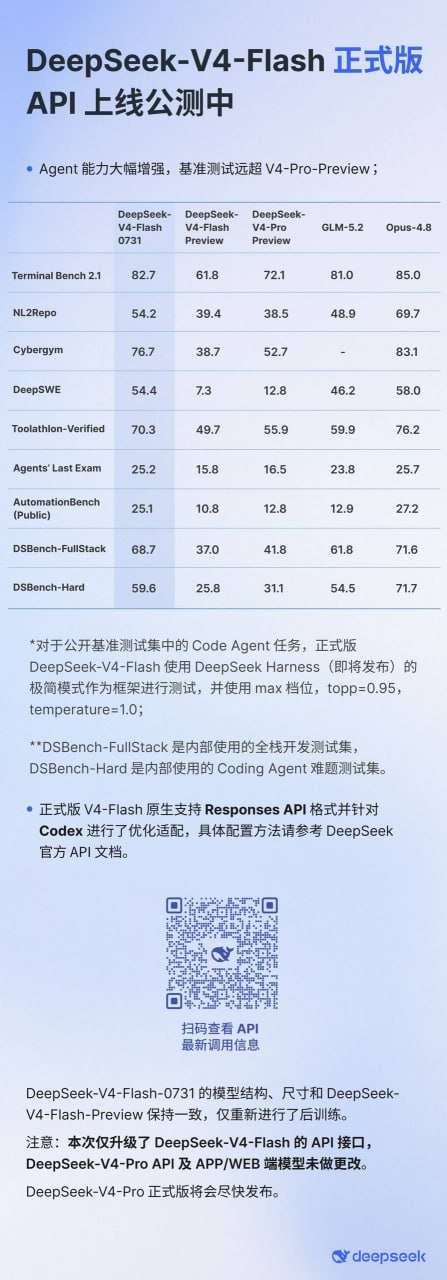
The scope matters. Public code-agent tasks used top_p=0.95, temperature=1.0 and max effort. DSBench-FullStack and DSBench-Hard are internal suites. CyberGym's public leaderboard does not yet show a V4-Flash 0731 entry, so 76.7 remains a vendor-reported result rather than an independently reproduced leaderboard score.
CyberGym contains 1,507 historical vulnerability instances from 188 large open-source projects. It measures whether an agent can generate a working proof of concept against an unpatched codebase. Agent scaffold and trial count can materially change the result, making release of DeepSeek's harness the first reproducibility checkpoint.
Codex support starts at the protocol layer
V4-Flash now accepts the Responses API format at https://api.deepseek.com under the model name deepseek-v4-flash. Developers can use the OpenAI SDK's client.responses.create() shape and configure Codex to call DeepSeek.
The compatibility table is more precise than the launch line. DeepSeek supports function tools, server-side web search and the custom apply_patch tool used by Codex, along with streaming SSE, reasoning effort and JSON output.
Protocol compatibility does not bring across the whole OpenAI Responses platform. DeepSeek does not support previous_response_id, conversations, storage, background mode or context management. Built-in file search, code interpreter, computer use and MCP tools are ignored. The endpoint is stateless, so clients must resend multi-turn context.
That is enough for a basic edit-run-search loop, but hosted sessions, long-running background jobs, MCP toolchains and cross-turn state still have to come from the client or the application team.
Benchmark gains without a price increase
DeepSeek lists V4-Flash at RMB 0.02 per million cached input tokens, RMB 1 for uncached input and RMB 2 for output. It supports a one-million-token context, up to 384,000 output tokens and an account concurrency limit of 2,500. V4-Pro is listed at RMB 0.025, RMB 3 and RMB 6 for the same three billing categories, with a concurrency limit of 500.
Responses API currently supports only V4-Flash. DeepSeek says V4-Pro support is due in early August, with the final Pro model to follow. The next checks are the public harness release, independent reproduction of 82.7 and 76.7, and real task completion rates and token consumption at the advertised price.
Sources: DeepSeek API changelog, Responses API and pricing documentation; CocoLoop; DeepSeek V4 technical report and Hugging Face model card for the 284B/13B architecture, 1M context and preview baselines; CyberGym public site for benchmark definition and reproduction status.