
Runway has published the weights of Praxis-1, its robotics "world action model," under the Apache 2.0 license, with commercial use allowed. The model first appeared in September, when only partners could try it. Now any robotics developer or researcher can download, deploy and fine-tune it.
Praxis-1 is a 27-billion-parameter mixture-of-experts (MoE) diffusion transformer. Its distinguishing feature is that it predicts video and actions together: as the model rolls out the next few frames of the scene, it also outputs how the robot should move. It is pretrained on large-scale video. Runway notes one finding: pretraining on web video and on teleoperated robot video produced policies of comparable performance. The article does not disclose how much training data was used.
How it stacks up against comparable models
Runway cites results from Nvidia's RoboLab-120 leaderboard, counted over 1,200 episodes, with data as of November 2026:
| Model | RoboLab-120 success rate |
|---|---|
| Praxis-1 | 46.2% |
| FLUX 3 Action | 42.9% |
| Cosmos3 Nano | 36.8% |
| π0.5 | 28.0% |
The gap between first and second place is 3.3 percentage points, and the gap to π0.5 is 18.2 points. The rivals come from very different backgrounds: the Cosmos family is from Nvidia, which also maintains this leaderboard, while π0.5 comes from Physical Intelligence, a company that focuses on robot foundation models. A video-generation company's model ranking ahead of a chipmaker's and a robotics startup's suggests that, on this leaderboard at least, the approach of "learn to predict the picture first, then learn to act" is paying off.
Another result comes from SimplerEnv: after fine-tuning on an RT-1 robot it had not seen during training, Praxis-1 reached a success rate of 80.0%, against 52.4% for RT-1's own original policy. Both this figure and the leaderboard result were published by Runway and its partners, and no independent re-test has surfaced so far.
A 46.2% success rate is not low by robotics standards, but it also means the task failed in more than half of the episodes. The announcement gives only the aggregate success rate over 1,200 episodes, without breaking out which tasks pulled the number up and which dragged it down. For manufacturers hoping to put it on a production line, per-task reliability matters more than leaderboard position, and that data will have to come from the community running its own tests once the weights are out.
Partners already have it on real robots
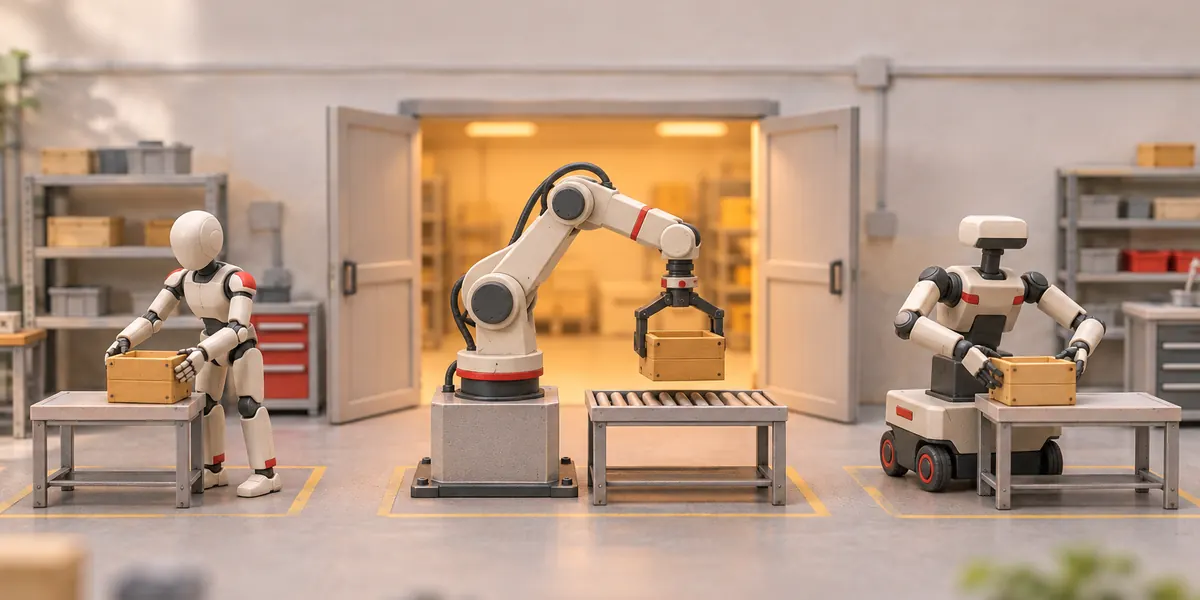
Before the weights went public, three partners had tested the model on their own hardware: Noble Machines' humanoid robot, Standard Bots' six-axis industrial arm, and Ultra's dual-arm warehouse robot. The three form factors differ widely, and Runway says LoRA adaptation is enough to connect a new body, camera and task without retraining the whole model.
"With LoRA you can adapt it to your own embodiment, cameras and tasks without retraining the full model."
On the runtime side, the Nvidia hardware Runway lists includes the H100, B200, RTX 5090 and RTX PRO 6000, plus Jetson Thor for on-robot deployment. The presence of a consumer card such as the RTX 5090 means small teams can run it locally for experiments, although the documentation says nothing about how much VRAM is required or what frame rate on-device inference can reach.
Where to get it
The weights and code live on GitHub at runwayml/praxis-1-oss and on Hugging Face at runwayml/praxis-1, the latter with native support for Hugging Face's LeRobot framework. vLLM-Omni and Reactor hosted inference are also integrated, and Nvidia NeMo Automodel provides a post-training tutorial. Teams planning production deployments are told to contact Runway's robotics team directly.
Runway's core business over the past few years has been video generation, from the Gen series to world models. By releasing for free a model that can run on robot arms and humanoids, the company is in effect handing the capability built up through video pretraining directly to the robotics industry.
Sources: CocoLoop, Runway's official announcement (used to verify parameter count, license, and the RoboLab-120 and SimplerEnv success rates and how they were counted), Runway developer page introducing Praxis-1.