
Zhipu released its flagship model GLM-5.4 on November 23, the first of its flagships to use a Loop Transformer architecture. The approach takes 28 layers from the 750B base of GLM-5 and runs that group of weight-sharing layers through two loops. The company says the parameter count does not grow, yet the model reaches the intelligence level of 2-3T-class models.
Starting today, GLM-5.4 is open to all GLM Coding Plan users and is rolling out to coding tools including ZCode, Trae, WorkBuddy and Qoder. Users on Coding Plan V2, V3 and the Team plan get 1.5 times the usual quota when they use GLM-5.4. The API will open only after a safety assessment is complete, and the model weights are "planned to be open-sourced in a responsible manner." Neither item comes with a timeline.
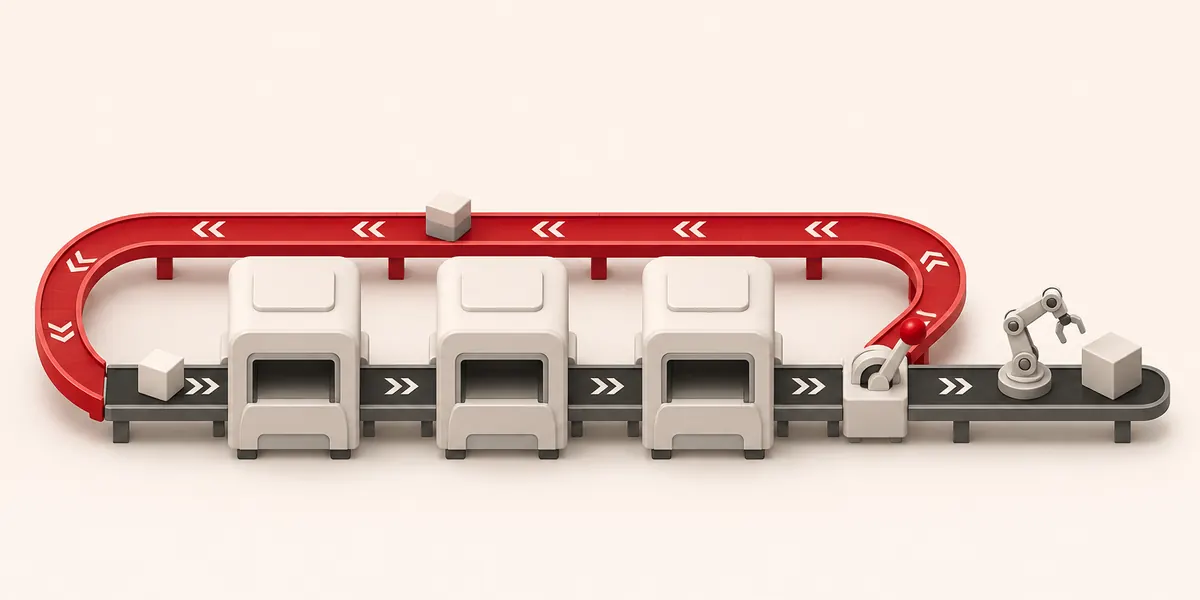
Running the same layers twice
In a standard Transformer, each layer runs once per forward pass. A Loop Transformer sends a group of layers through again, carrying the hidden state from the previous pass. The parameters stay the same, but the network becomes effectively deeper. In its technical note, Zhipu concedes the idea is not new: the 2018 Universal Transformer already proposed a weight-sharing deep structure. The trouble is that, at the same pre-training compute, models with shared weights have performed worse than those without.
Zhipu's answer is not to pre-train from scratch. Instead it converts an already-trained base model into a looped structure through post-training. For the 750B scale, the company lists three changes:
- Gated progressive updates: each loop has its own per-token gate that writes candidate changes back into the residual stream in proportion, which keeps activation norms from growing with each loop. After training, the first loop leans toward building global context and the second toward refinement.
- KV cache sharing across loops plus a sliding window: the second loop reuses the sparse KV selected in the first and keeps only the new KV inside a sliding window, so an extra loop does not require storing a whole extra cache.
- Reusing the sparse attention index: the second loop directly uses the first loop's indexer results, which the company says performs almost as well as recomputing them on every loop.
Before applying this to the flagship, Zhipu validated the approach step by step on base models of 1B, 4B, 30B and up to 750B. In a same-parameter-count comparison on a 30B model with the same architecture as the 750B base, total training compute rose by about 10%, and the Loop version improved over the baseline, with the largest gains in mathematical reasoning, long context and code.
There is also a side effect. On benchmarks such as GPQA and MMLU-Pro, the model's average output length fell by 10%-14%, mostly from shorter chains of thought. Zhipu's explanation is that part of the reasoning has moved out of the token stream and into the extra depth the loop provides.
"Generalized coding" and 200 hands-on tasks
Zhipu calls the direction for this generation "generalized coding," meaning using code to do things beyond programming. The company gave three examples: a music video whose visuals are drawn entirely in real time by front-end code, with no image assets; an interactive bird-watching scene generated purely from mathematical geometry and GLSL shaders, with no external 3D models or textures; and a six-axis robot arm modeled in FreeCAD, then animated through Blender for motion simulation.
On evaluation, the company says it ran a hands-on coding test of 200 real-world scenarios and concluded that GLM-5.4 is "still the Chinese model with the strongest feel for coding," standing out in visual coding, visual replication and long-horizon tasks. The 200 tasks and per-item scores were not published with the announcement, and the models it was compared against were not disclosed. Results on public leaderboards such as SWE-bench are also absent, so for now Zhipu's own account is the only one to go on.
The company also states a downside: the model tends to slip into long stretches of thinking. Zhipu's position is that this long thinking keeps improving results, with the model reflecting and correcting itself along the way.
On speed, GLM-5.4 reaches up to 200 tokens/s during off-peak hours and 70-80 tokens/s during peak hours.
What developers in China can use right now
For users in China, the only entry points at the moment are the subscription and partner tools. The launch list includes Zhipu's own ZCode, Zhipu Qingyan and AutoClaw, along with Doubao Work, Qwen Office, Trae, Qoder, WorkBuddy, CatPaw, Madao, Baidu Dazi Enterprise Edition and OpenCode, covering coding or office products from ByteDance, Alibaba, Tencent, Meituan and Baidu. Teams that want to call the model on a pay-as-you-go basis in their own services must wait for the API, and those who want to deploy locally must wait for the weights.
A 750B base with a looped structure will not be light on GPU memory or inference frameworks. Zhipu says only that the growth in deployment cost at 1M context relative to GLM-5.3 "stays manageable" and gives no specific multiple. Once the weights are out, whether the community can run the looped layers and sliding-window KV in existing inference frameworks will depend on the implementation details published at that point.
At the end of its note, Zhipu previews that its next model will be "significantly larger" and will carry forward this approach of adding compute depth. How returns change when the loop goes beyond two passes, and whether compute can be allocated according to token difficulty, are two questions the company lists as still unanswered.
Sources: Zhipu's official technical note, CocoLoop, the GLM Coding Plan page; used to check loop layer count, base model size, training compute increase and speed figures.